
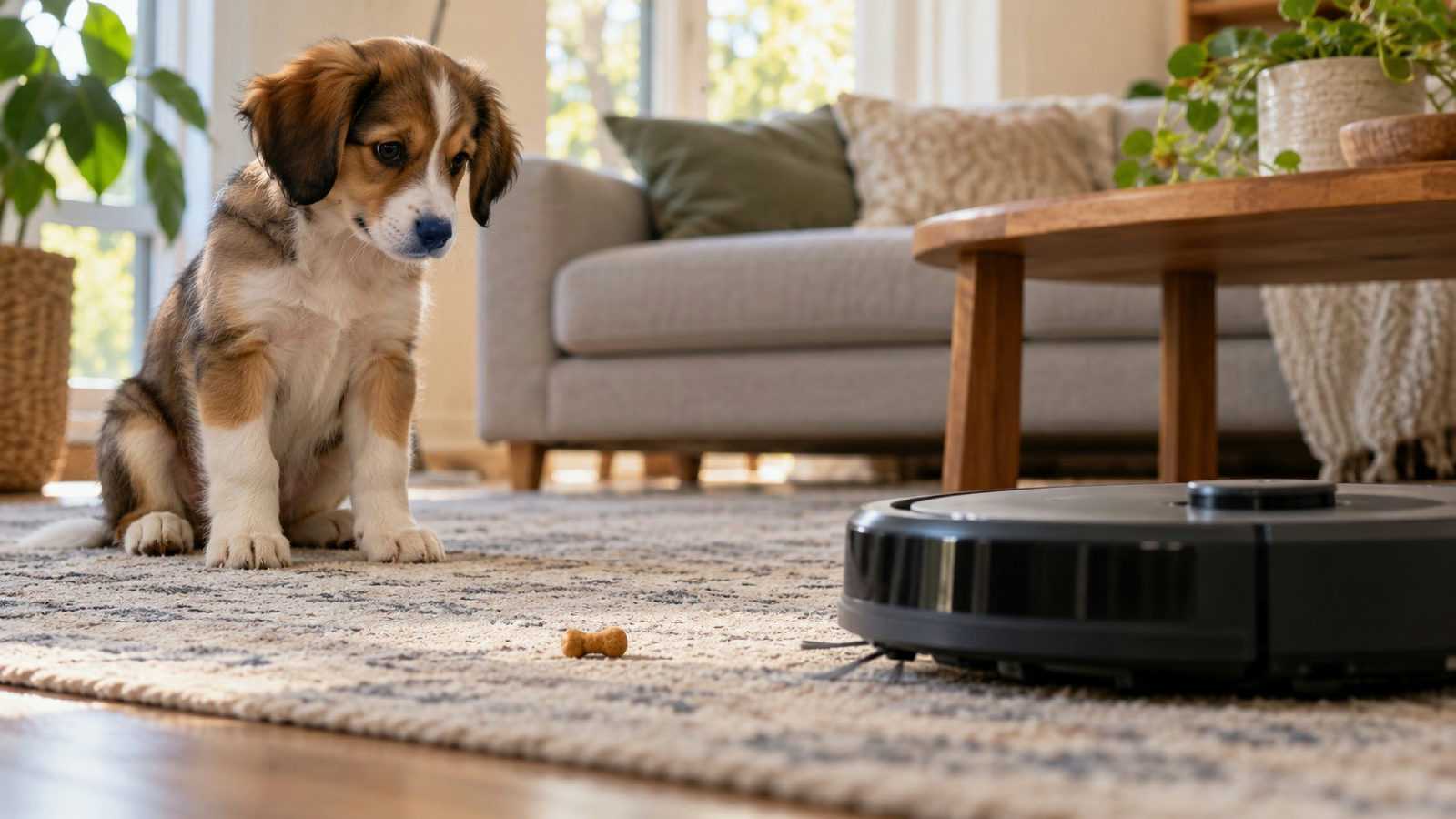
The calmest way to get a puppy used to household noises is to start with the sound quiet and far away, pair it with something your puppy already loves, and only turn it up or bring it closer while your puppy stays relaxed. Short, happy sessions spread over days and weeks are the whole plan. Let your puppy set the pace, watch their body language, and stop before it becomes too much.
A quick note on who is writing: this is general, enthusiast-level guidance from a puppy notebook, not advice from a trainer or a vet, and it is not a fix for a specific behavior issue. If your puppy’s fear seems intense, or it isn’t easing, please loop in a professional trainer or your vet. If this feels bigger than socialization, they can help in a way a blog post can’t.
Starting from wherever you are
If your puppy already startles at the blender, take a breath. Lots of new owners find themselves googling “is it too late” around week ten. This guide doesn’t ask you to hit a deadline; it is a calm routine you can start today, at whatever level your puppy is comfortable with. If you are worried about timing for your own puppy, your vet or a trainer is the right person to ask. For background reading, the American Veterinary Society of Animal Behavior publishes a puppy socialization position statement.
Which household sounds to start with
Homes are noisy places. A little planning lets you introduce everyday sounds in an order that feels manageable for both of you.
Make a simple sound list
Walk through your home and jot down the sounds your puppy will hear regularly. A starter list might look like this:
- Cleaning: vacuum, robot vacuum, mop bucket, spray bottles
- Kitchen: blender, coffee grinder, dishwasher, pots and pans, microwave beeps
- Laundry: washing machine spin cycle, dryer buzzer
- Doors and visitors: doorbell, knocking, keys, the garage door
- Personal care: hair dryer, electric razor, electric toothbrush
- Everyday life: TV, music, phone ringtones, kids playing
Order them from easy to harder
Put the softer, predictable sounds you can control at the top, such as the microwave or the TV at low volume. Put the louder, moving or sudden ones, like the vacuum or the doorbell, further down. You can always reorder the list once you see how your puppy responds. Every puppy is different, so your list will look different from anyone else’s.
Starting quiet and far away
The two simplest levers you have are volume and distance. Small, calm exposures at a level your puppy barely notices are the starting point.
Use distance first
Run the appliance in a different room while your puppy relaxes with you somewhere else. If they notice the sound but keep sniffing, playing or chewing, that is a good place to begin.
Use recordings for control
Recorded sounds let you control volume very precisely. Play a recording of a doorbell or vacuum at a very low volume on a phone or speaker. If your puppy stays relaxed, you have found your starting level. Ordinary recordings you already have access to are fine; there is no need to buy anything special.
Keep the machine still at first
For the vacuum, try leaving it switched off in the room for a few days so your puppy can sniff and investigate it like a piece of furniture. Then switch it on in another room, still not moving. Only later move it around, and keep it well away from your puppy.
Pairing sounds with treats and play
The idea is simple: the sound shows up, and then something your puppy likes shows up. No scolding, no pushing, just treats and play. If you want to read more about gentle, reward-based approaches, the AVSAB’s humane dog training position statement is a good place to start.
The basic pattern
- Sound starts at a very low level your puppy can handle.
- Good things start: small, tasty treats or a favorite toy game.
- Sound stops, and the treats or play stop too.
- Repeat a few times, then end the session while it is still easy.
Keep the order the same each time: sound first, good stuff second. A few minutes at a time is plenty.
Ideas that fit everyday life
- Scatter a few treats on the floor while the dishwasher runs in the next room.
- Give a stuffed chew toy or lick mat during the washing machine’s spin cycle.
- Play a short tug game while someone runs the blender across the house.
- Feed part of a meal from a puzzle toy while the robot vacuum runs in another room.
Let your puppy choose
Always let your puppy move away if they want to. Don’t hold them in place, carry them toward a sound or corner them near a machine. If your puppy wants to watch from the doorway instead of joining in, that is a completely valid choice.
Getting the whole household on board
Sound practice is easier when everyone at home follows the same plan. Let family members or roommates know which sounds you are working on and at what level. Ask them to give you a heads-up before running a loud appliance, so you can grab treats or move your puppy to a quieter room. A simple note on the fridge listing “today’s sounds” helps. Kids can join in by tossing treats while a parent runs the blender, which turns practice into a family game rather than a chore.
Building up gradually
Once your puppy stays relaxed at one level, you can make it a little harder. Change only one thing at a time.
Ways to increase the challenge
- Volume: turn a recording up a notch.
- Distance: run the appliance one room closer.
- Duration: let the sound run a little longer.
- Movement: move the vacuum slowly, far from your puppy.
- Surprise: later, practice sounds that start without warning, like a doorbell.
A sample week for the vacuum
- Days 1 and 2: vacuum switched off in the living room, treats nearby.
- Days 3 and 4: vacuum on in another room for a short time while your puppy gets a chew.
- Days 5 and 6: vacuum on in the same room, not moving, at a good distance.
- Day 7 onward: slow, short movements far from your puppy, with treats or play.
This is just an example. Some puppies move through the steps in a few days, others need weeks, and both are fine. Progress, not perfection.
Doorbells and knocking
Doorbells can be extra exciting because they often mean visitors. Play a doorbell recording at low volume and toss a treat. Later, have a family member ring the real bell while you reward calm behavior. This also gives you a head start on calmer greetings when guests arrive.
Sounds you can’t control
Some noises happen whether you are ready or not, like a dropped pan or a neighbor’s leaf blower. When a surprise sound startles your puppy, stay calm, give them a moment, and offer a treat or a short game once they settle. If you can, add a recording of that sound to your practice list later so it becomes more familiar.
For more calm exposure ideas, browse the other guides on Puppy Socialization.
A simple sound log
A notebook or a note on your phone makes it much easier to see progress. After each session, jot down:
- The date and the sound you practiced
- Where it was (which room, how far away)
- The level (volume, how long it ran, still or moving)
- How your puppy looked: relaxed, curious, unsure or worried
- Whether they still took treats
- What you will try next time: same level, one step harder, or one step easier
Looking back over a week of notes helps you see small wins, which are easy to forget without a record. A log is also handy to share if you ever talk to a trainer or your vet.
Signs your puppy needs a break
This guide uses one simple house rule: if you notice any of the following during a session, end the session and make the next one easier. You don’t need to work out what it means; just step back and note it in your log.
- Freezing or going very still
- Tail tucked, ears pinned back or body low to the ground
- Trying to hide, leave or climb into your lap
- Yawning, lip licking or shaking off when not tired or wet
- Refusing treats they normally love
- Barking, whining or trembling
What to do
Calmly end the sound, add distance and give your puppy space and a quiet moment with you. Next time, start at an easier level and write it down in your log.
When to ask for help
If your puppy panics, takes a long time to recover, or seems to be getting more worried over time rather than less, that is a good moment to loop in a professional trainer or your vet. Bring your sound log along. Asking early is not a failure; it is exactly the right call.
FAQs
How long does it take to get a puppy used to household noises?
There’s no set timeline, and every puppy is different. Your sound log is the best guide to your own puppy’s pace.
Is it too late if my puppy is already older?
The routine in this guide is the same at any age: start at a level your dog is comfortable with and go slowly. If you are worried about your puppy’s age or progress, your vet or a trainer can talk it through with you.
Should I just run the vacuum and let my puppy get over it?
This guide takes the slower route on purpose: start quiet and far away and build up gradually, so your puppy can stay relaxed the whole time.
Do I need special sound recordings?
No. Recordings are handy because the volume is easy to control, but everyday sounds introduced slowly work alongside them.
What if only one sound bothers my puppy?
That is common. Focus on that one sound using the same steps, and keep practicing the others your puppy already handles well.
Small wins count. Every calm minute near a noisy machine is a step forward.
Further reading
- AVSAB puppy socialization position statement, a professional body’s view on the early months
- AVSAB humane dog training position statement (2021)

