
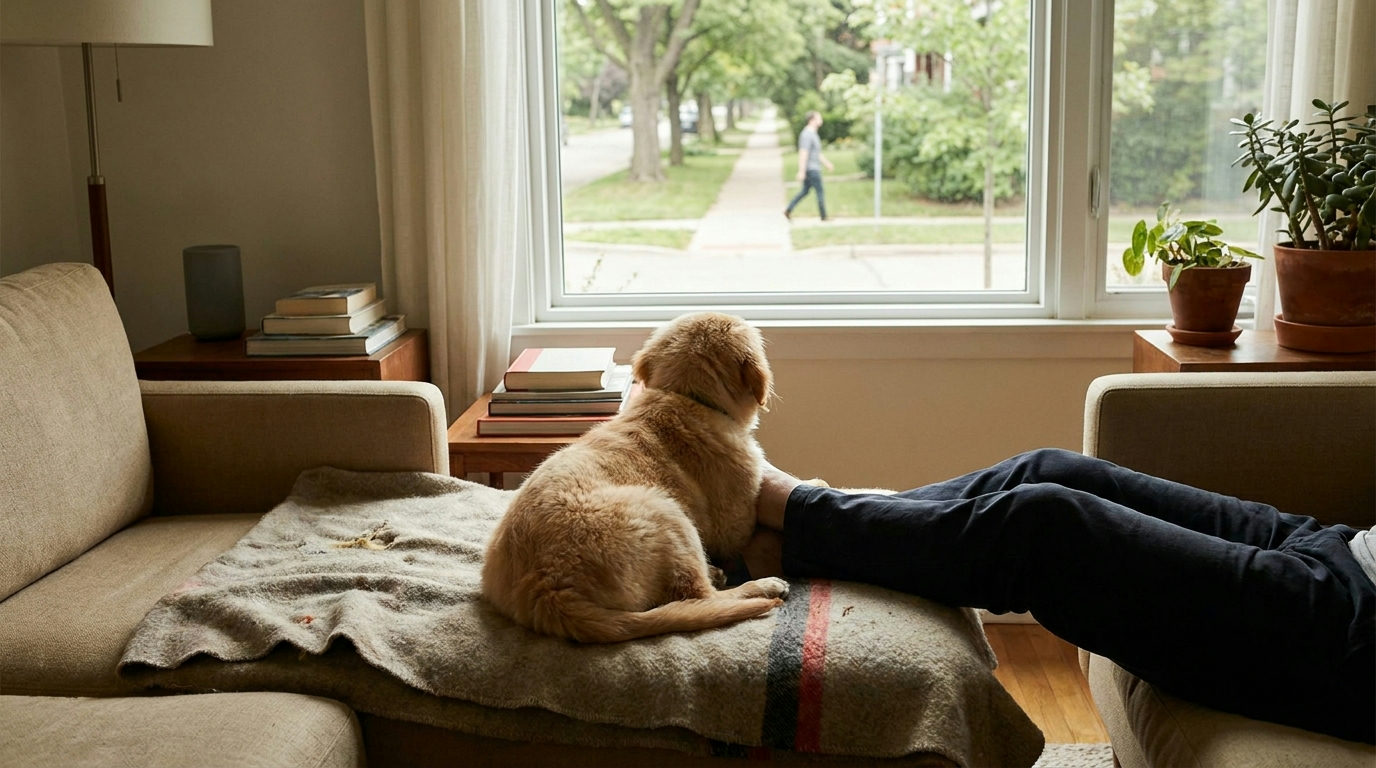
A puppy can learn about people without meeting every person who walks past. Watching calmly from a comfortable distance can be a useful socialization experience, especially when a close greeting would be too much. The goal is to help your puppy notice ordinary movement and remain able to relax, not to collect a certain number of handshakes. This guide shows how to set up a gentle observation session. For a broader overview, the AKC puppy socialization guide is a useful reference.
Who this is for: Owners of puppies learning about people in a quiet home, yard, or veterinarian-approved outdoor setting. Ask your veterinarian which public spaces are appropriate for your puppy’s health and vaccination situation. If your puppy seems persistently worried rather than briefly cautious, an individual session with a qualified reward-based professional can help.
Quick plan: observe before greeting
- Choose a place where your puppy can see people from a comfortable distance.
- Keep a clear route away from the view.
- Watch your puppy’s body and ability to engage with you.
- Offer a suitable reward while the puppy remains comfortable.
- Leave or add distance if the puppy becomes worried.
Why watching can be enough
Many people enjoy puppies and want to approach. A puppy, however, may need time to look, sniff, and understand a new person before contact. A puppy does not have to be pushed through a list of experiences that feel overwhelming; watching from the sidelines is a real option. An observation session gives the puppy information without requiring a stranger to touch them.
This does not mean avoiding people forever. It means choosing a manageable step today. A puppy who can see someone at a distance, eat a treat, and return to a familiar activity is showing you useful information. A close greeting may become an option later if the puppy is comfortable and the situation is appropriate. The puppy’s response, not the owner’s calendar, should guide that decision.
Find a quiet place with an exit
You can begin at a window where people pass, a supervised yard, or another low-pressure place approved by your veterinarian. Avoid a narrow space where people must pass right beside the puppy. Keep a familiar resting area available and enough room to turn away. If you are outside, use safe management that suits your puppy and environment; do not leave a puppy unattended near a gate or public walkway. For indoor practice, keep visitors from crowding the viewing spot.
Stand or sit beside your puppy without holding them in place. If a person appears far away, notice whether the puppy can look and then re-engage with you. If the puppy moves away, let them. If they remain relaxed, you can quietly praise or offer an appropriate treat.
Choose distance by the puppy’s response
There is no universal number of steps that makes a person “far enough.” Start where your puppy can notice without becoming overwhelmed. If the puppy freezes, pulls hard away, hides, or cannot settle, increase distance or end the session. If the puppy moves away, let them, and do not use food to pull them closer. If the puppy can remain comfortable, stay at that distance for a short observation rather than immediately moving forward.
You can also read the AKC’s home socialization guide for more everyday examples. Make only one change at a time. For example, on another day you might watch from a slightly different window or at a different time. Do not combine closer distance, a larger crowd, and a longer session in one outing. A small, pleasant session is a sound starting point.
How to handle a person who wants to pet your puppy
You can politely say, “We’re practicing watching today, so please give us space.” You do not owe a greeting. Ask the person not to reach over the puppy or follow them if they step away. If the puppy is already comfortable and you want to allow interaction, make sure the person can follow your instructions and the puppy can choose to approach and leave. Keep the interaction brief, and watch your puppy’s body language throughout.
Children may move quickly or speak loudly. If your puppy has not practiced around children, observing them from a safe distance is enough for a first session. Do not use a child as an experiment to see whether the puppy is friendly. Ask adults to supervise both sides. If the puppy appears worried, separate them calmly and seek advice before trying again. The focus here is controlled observation, not a meeting with every type of person.
Use rewards without forcing approach
Praise, play, and suitable treats can help make a new experience positive. You can reward the puppy for calmly noticing someone or turning back toward you. The reward should be available where the puppy already feels safe. Do not place it at a stranger’s feet to make a hesitant puppy move closer. If the puppy is too worried to take a normally welcome treat, increase distance and lower the pressure.
Some puppies would rather play briefly or receive gentle praise. Watch which response helps yours stay comfortable. Keep the session short and end on a calm note. A treat is a tool for a positive association, not proof that the puppy was comfortable. Look at movement, ability to rest, and willingness to return to normal behavior afterward.
Keep a simple observation log
After each session, write one or two facts: where you were, how far away people were, whether they moved or stood still, and what your puppy did. Avoid labels like “bad with strangers.” A useful note might be, “Watched one walker across the street, took a treat, then sniffed the ground.” Another might be, “Moved behind me when three people approached; we left.” These details help you plan an easier next step and explain the situation if you seek professional advice.
Do not turn the log into a quota of new people per day. Some days your puppy may need rest or familiar routines. You can repeat a comfortable observation several times before changing the setting.
When a greeting might make sense
A greeting can be considered when the puppy is relaxed, the person can follow directions, and the location is suitable. Give the puppy room to approach voluntarily. Ask the person to avoid leaning over or grabbing. Stop if the puppy wants to leave. If you are uncertain, skip the greeting and continue observing. A puppy can have a useful outing without physical contact with a stranger.
If your puppy repeatedly seems worried even at a large distance, ask your veterinarian and a qualified reward-based behavior professional for an individual plan. Do not keep repeating sessions that feel like too much. A short, calm session that ends well is more useful than a longer one the puppy struggles through.
Make room for different kinds of people over time
As your puppy grows comfortable, they may see people with hats, umbrellas, bags, or different ways of moving. You do not need to arrange all of these in one day. Let your puppy watch one manageable scene and return to normal life. If a new object or movement is surprising, add distance and try another day.
Letting your puppy watch people without a forced greeting respects the puppy’s pace and gives you clear feedback. Choose a safe place, keep an exit, reward comfort, and stop when the puppy needs a break. The quiet moments of observation count as socialization too.
Common questions
Does my puppy have to meet every neighbor?
No. Watching calmly is a valid first step. A greeting can wait until your puppy is comfortable and the situation is suitable.
What if a stranger approaches anyway?
Ask for space, move away with your puppy, and return to an easier location. You can end the session without explaining more.

