
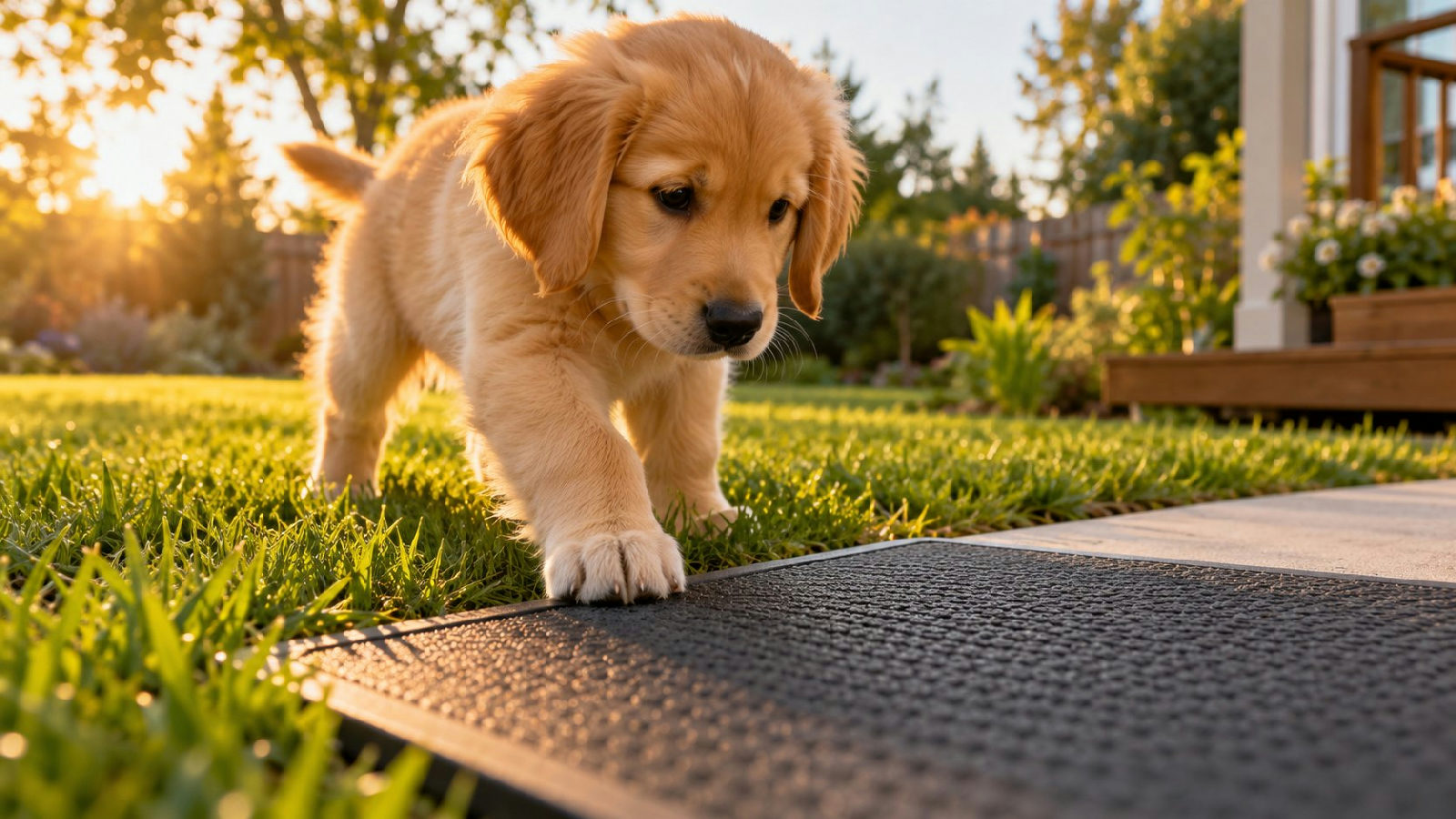
The calmest way to approach puppy surface socialization is to start with one easy texture at home, invite your puppy onto it with a treat, and only add something new while your puppy stays relaxed. Short, happy sessions spread over days and weeks are the whole plan. Let your puppy set the pace, watch their body language, and stop before it becomes too much.
A quick note on who is writing: this is general, enthusiast-level guidance from a puppy notebook, not advice from a trainer or a vet, and it is not a fix for a specific behavior issue. If your puppy seems very worried about new footing, or has any trouble moving comfortably, please loop in a professional trainer or your vet. They can help in a way a blog post can’t.
Puppy surface socialization: grass, tile, grates and stairs in five steps
If you only read one section, make it this one. Here is the routine this guide builds on:
- Make a surface list of the textures your puppy will walk on at home and out and about.
- Start with the easiest one, laid flat and stable in a quiet room.
- Toss a treat near the edge, then on the edge, then a little farther on, and let your puppy choose whether to follow.
- Stop after a few minutes, while it still feels easy.
- Write it down in a simple surface log, then pick the next small step for another day.
For stairs, there is one extra step before any of this: ask your vet what is appropriate for your puppy.
Starting from wherever you are
If your puppy already plants their feet at the edge of the kitchen tile, take a breath. A lot of new owners find themselves with a puppy who loves the rug and wants nothing to do with the hallway. This guide doesn’t ask you to hit a deadline; it is a calm routine you can start today, at whatever level your puppy is comfortable with. If you have questions about timing for your own puppy, your vet or a trainer is the right person to ask. For background reading, the American Veterinary Society of Animal Behavior publishes a puppy socialization position statement.
Make a simple surface list
Walk through your home, yard and usual walking routes and jot down the surfaces your puppy is likely to meet. A starter list might look like this:
- Soft: a folded towel, a bath mat, a dog bed, a couch cushion on the floor
- Crinkly: a flattened cardboard box, a crinkly tarp, a paper bag opened flat
- Bumpy: a rubber doormat, a textured yoga mat
- Smooth indoors: tile, hardwood, vinyl, a polished entryway
- Outdoors: grass, wet grass, mulch, sand, paving stones, small gravel, fallen leaves
- Out and about: sidewalk grates, drain covers, wooden footbridges, boardwalks
- Steps: a single low step, porch steps, indoor stairs (vet check first)
Order them from easy to harder
Put the flat, quiet, familiar-feeling surfaces at the top, like a towel or a bath mat. Put anything that moves, echoes, crinkles loudly or has gaps further down. You can always reorder the list once you see how your puppy responds. Every puppy is different, so your list will look different from anyone else’s.
Building a mini surface course at home
You don’t need special equipment. Most of the items on a starter list are already in your house or garage.
Setting it up
Lay two or three items flat on the floor in a quiet room. Check that each one is stable and won’t slide. Put the easiest one closest to where your puppy usually relaxes. That’s it; the course is ready.
The basic game
- Toss a treat near the edge of the new surface.
- Toss the next one right on the edge, so a paw could touch it.
- Then a little farther onto the surface, only if your puppy is happily following.
- Mark any curiosity with a treat, even a sniff or a single paw.
- End after a few minutes, while your puppy is still keen.
Keep the order the same each time, and swap in a new item every few days. A few minutes at a time is plenty.
Let your puppy choose
Let your puppy walk off the surface whenever they like. Don’t pull them on with the leash, push them from behind or set them down in the middle of something new. If your puppy prefers to sniff the edge today, that is a completely valid choice, and it goes in the log as a step.
Getting the household on board
Surface games are easier when everyone at home follows the same plan. Let family members know which surface you are working on, and ask them not to lift your puppy onto it “to show them it’s fine.” Kids can help by tossing treats near the edge under adult supervision, which turns practice into a family game.
Grass, mulch and other outdoor textures
Once the home course feels easy, outdoor textures are a natural next step. Start in your own yard or another quiet, familiar spot if you have one.
- Play the same treat game at the edge where the patio meets the grass.
- Try a short sniff around a patch of mulch or leaves.
- Visit wet grass after rain, or a patch of sand, for a minute or two.
- Keep sessions short in very cold, hot or wet weather, and ask your vet if you have questions about what conditions suit your puppy.
For parks, paths and other public places, ask your vet when those fit into your puppy’s plan, since that depends on your individual puppy.
Tile, hardwood and other smooth floors
Smooth floors are often the first surface owners notice their puppy hesitating on, because they are right there in the house.
Small steps for smooth floors
- Lay a path. Put down runners, yoga mats or towels to make a grippy trail across the room. Over days or weeks, take one piece away at a time.
- Keep it calm. Save zoomies for the rug or the yard at first, and play slower games on the smooth floor.
- Ask about nail care. If you have questions about your puppy’s nails, ask your vet or groomer.
- Try a new place later. Once home floors feel easy, a pet-friendly store with a smooth floor is a possible next step, at a quiet time of day.
Metal grates, bridges and wobbly things
These are later items on most lists. Save them until the home course and outdoor textures feel easy.
Grates and drain covers
Stand next to a grate and let your puppy sniff it from the sidewalk. Toss a treat beside it. If your puppy chooses to step on, great. If not, walk around it and try another day. Pick grates with narrow openings for practice, and skip any you’re unsure about.
Bridges and boardwalks
Start with a short, sturdy footbridge on a quiet day. Keep the leash loose, walk slowly, and offer a treat at the start and the end. Turning back halfway is fine.
Wobbly surfaces
If you want to try something with a little movement, like a cushion on the floor, keep the movement minimal, stay close and let your puppy step off whenever they want. If you’re unsure whether a piece of equipment suits your puppy, ask a trainer or your vet before using it.
Stairs: ask your vet first
Stairs get their own section because there is a vet question to answer before you practice. Ask your vet what is appropriate for your puppy, including whether to practice stairs yet and how many steps. This guide doesn’t cover joints, growth or any medical side of stairs; that conversation belongs with your vet.
If your vet says it’s okay
- Start with one low step, like a single porch step.
- Place a treat on the step and let your puppy decide whether to reach or climb.
- Stay right beside your puppy on every attempt.
- Carry them down if coming down looks like too much today.
- Use a gate at the top and bottom of stairs when you are not supervising.
Open-backed stairs and outdoor steps with gaps can wait until solid steps feel easy.
For more calm exposure ideas, browse the other guides on Puppy Socialization.
A simple surface log
A notebook or a note on your phone makes it much easier to see progress. After each session, jot down:
- The date and the surface you practiced
- Where it was (which room or which spot outside)
- How far your puppy went: sniffed the edge, one paw, all four paws, walked across
- How your puppy looked: relaxed, curious, unsure or worried
- Whether they still took treats
- What you will try next time: same step, one step harder, or one step easier
Looking back over a week of notes helps you see small wins, which are easy to forget without a record. A log is also handy to share if you ever talk to a trainer or your vet.
Signs your puppy needs a break
This guide uses one simple house rule: if you notice any of the following during a session, end the session and make the next one easier. You don’t need to work out what it means; just step back and note it in your log.
- Stopping at the edge and leaning back
- Freezing or going very still
- Tail tucked, ears pinned back or body low to the ground
- Trying to leave, hide or climb into your lap
- Yawning, lip licking or shaking off when not tired or wet
- Refusing treats they normally love
What to do
Calmly move away from the surface and give your puppy a quiet moment with you. Next time, go back to an easier surface or a smaller piece of the same one, and write it down in your log.
When to loop in a trainer or your vet
Some things are bigger than a surface game. Loop in a professional trainer or your vet if:
- Your puppy panics or takes a long time to settle after a session
- Your puppy seems more worried over time rather than less
- Your puppy limps, seems sore, or has any trouble walking, standing or climbing
- You have any question about stairs, jumping, or your puppy’s growth
- You’re unsure whether a surface or piece of equipment suits your puppy
Questions to bring along
- Is stair practice appropriate for my puppy right now, and how much?
- When do outdoor public places fit into my puppy’s plan?
- Is there anything about my puppy’s movement you’d like me to watch for?
- What would you suggest as a next step, based on my surface log?
Bring your surface log along. Asking early is not a failure; it is exactly the right call.
FAQs
When should I start puppy surface socialization?
Many owners start the home course soon after their puppy arrives. For public places and stairs, ask your vet what fits your puppy.
My puppy won’t step on one surface. What should I do?
Make it easier: a smaller piece of that material, a towel over part of it, or treats right at the edge. Then stop for the day and try again another time.
Is it okay to carry my puppy over a tricky spot?
Yes. If you need to get somewhere, carrying your puppy is fine. Practice that surface another day when you have time to go slowly.
How long should sessions be?
A few minutes at a time is plenty. Your surface log is the best guide to your own puppy’s pace.
Do I need to buy special equipment?
No. Towels, mats, cardboard and the floors you already have are enough to start.
Progress, not perfection. Every curious paw counts.
Further reading
- AVSAB puppy socialization position statement, a professional body’s view on the early months
- AVSAB humane dog training position statement (2021)

