
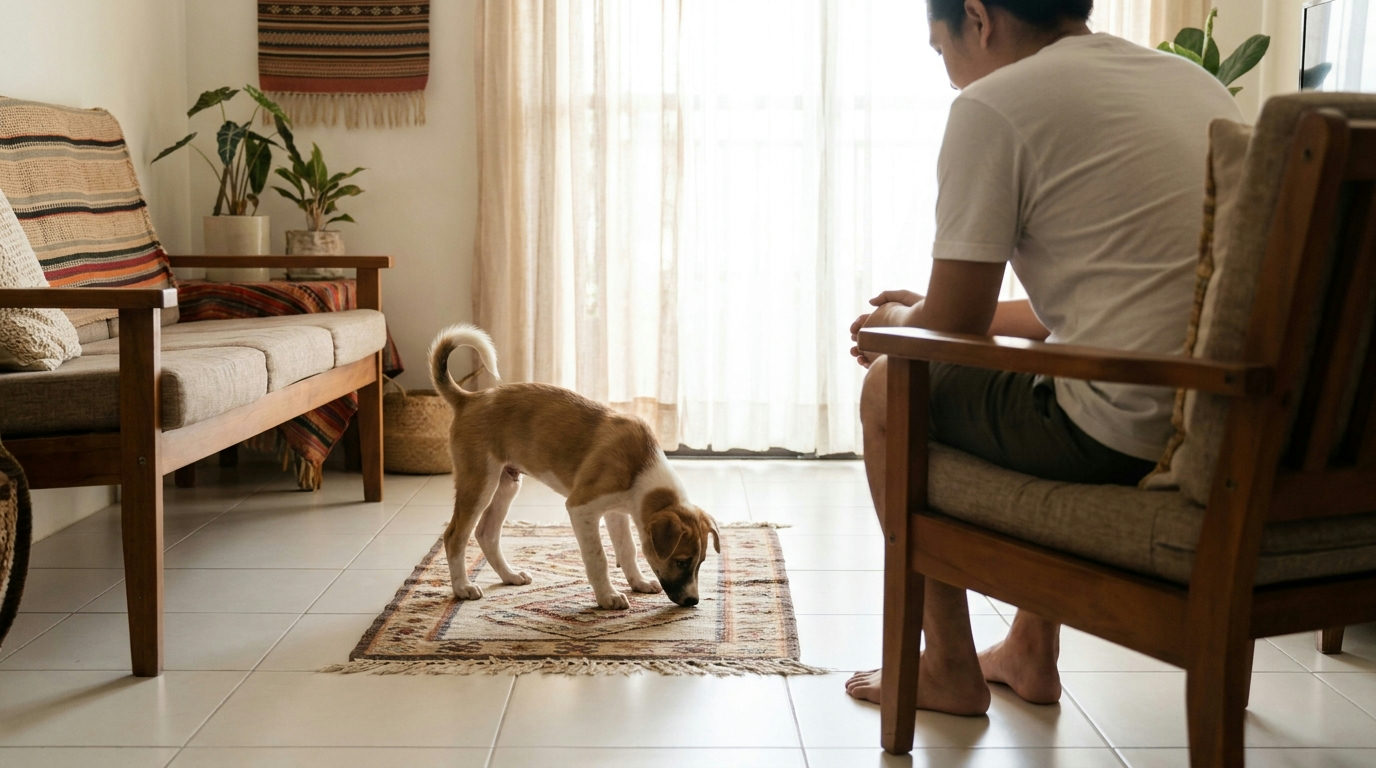
A kitchen floor, a small rug, and a quiet patch of grass can each feel different to a young puppy. You do not need a busy outing to offer a new experience. Introducing your puppy to new surfaces at home gives you control over the space, pace, and chance to pause. The goal is a calm, positive encounter, not a test the puppy must pass. The American Kennel Club’s socialization guide includes a variety of textures among the everyday experiences puppies can meet. Watch the puppy in front of you and keep each session simple.
Who this is for: New puppy owners who want gentle, supervised ways to explore ordinary household and yard surfaces. This is general behavior guidance. Ask your veterinarian about health, vaccination, and where your particular puppy can safely go; seek a qualified positive-reinforcement professional if fear persists.
Quick plan: one surface, one short session
- Choose a quiet, clean, stable surface your puppy can approach voluntarily.
- Let the puppy look and sniff before asking for a step.
- Use praise or an appropriate treat if the puppy is comfortable.
- Pause or move away if the puppy seems worried.
- Finish while the puppy is still at ease and note what worked.
Why introduce your puppy to new surfaces at home?
Socialization includes sights, sounds, smells, people, and textures. The AKC guide to socializing from home lists surfaces such as carpet, wood, grass, and gravel as examples of experiences that can be introduced positively. Home gives you room to choose a quiet time and make a change if the puppy needs space. It also makes it easier to repeat a comfortable experience without turning every day into a trip.
The aim is familiarity, not a checklist of every surface you can find. A puppy who is happy to step onto a mat has already had one useful experience. There is no need to rush to wet grass, noisy sidewalks, or unfamiliar places on the same day. As the AKC preparation guide advises, let the puppy set the pace and do not force interactions. Apply that same approach to a new texture under the paws.
Start with the floor your puppy already knows
Watch where the puppy moves easily during a normal day. A familiar room can be your starting place. Put a small, stable mat beside the usual path, leaving enough space for the puppy to go around it. Sit nearby without blocking the way. If the puppy chooses to sniff or step on it, respond calmly and reward if that suits your routine. If the puppy walks past, that is information, not failure. Try again later when the room is quiet.
Avoid sliding the mat toward the puppy or placing the puppy on it. That removes the choice to approach or retreat. If the puppy will not step on the whole mat, noticing or sniffing from a short distance can be the first step. Keep the mat from curling or slipping so the experience stays predictable. Supervise any fabric item and remove it if the puppy begins to chew or swallow pieces.
Move from easy textures to modest changes
After a comfortable experience on one surface, you might offer a different rug, a dry tile patch, or another ordinary texture already in your home. Change one feature at a time. If the puppy was relaxed on a small rug, a similar rug in another quiet room is an easier comparison than a sudden trip to a crowded outdoor space. Keep a familiar path available. A puppy should be able to leave the new surface without being pulled back.
For an outdoor option such as a yard, ask your veterinarian what is appropriate for the puppy’s vaccination and health situation. The advice can depend on local risks and your own space. The goal of this article is the behavior side: choose a manageable surface and let the puppy explore calmly. Do not use unknown public areas simply to complete a texture list. You can build a varied routine inside your home while following veterinary guidance.
Notice what your puppy is telling you
Look for an easy approach, relaxed movement, and the ability to take a break. If the puppy freezes, tries to escape, will not take a normally welcome reward, or seems increasingly distressed, increase distance or end the session. Avoid holding the puppy in place until it “gets used to it.” The AKC article on gentle socialization cautions against turning puppyhood into a forced bucket list of experiences. A calm pause is often more useful than pushing for one more step.
Not every hesitation is a lasting problem. A puppy may simply need time to look and sniff. Give that time without a crowd watching. If distress is strong or repeats across ordinary situations, ask a veterinarian or qualified reward-based behavior professional for an individual plan. Do not treat a short article as a diagnosis. Write down the surface, environment, and response so you can describe exactly what happened.
Make rewards part of the experience, not a lure into panic
Praise and treats can help make a new experience positive, as described in the AKC socialization guide. Offer them when the puppy is comfortable enough to choose an action. You can place a treat near the edge of a mat, but do not keep moving it deeper while the puppy is visibly worried. If the puppy does not want food, give space and try an easier step later. Use treats that are appropriate for your puppy’s diet and any advice from your veterinarian.
Some puppies prefer a familiar toy or gentle praise. You do not need to make every surface a formal training drill. A short voluntary exploration followed by a normal rest period is enough. Keep the routine easy for the household to repeat: set out one item, supervise, reward calm interest, then put it away. If many people are present, ask one person to guide the session so the puppy is not surrounded by voices and hands.
Try a simple three-day home routine
On the first day, offer one stable mat near a familiar path and observe without asking for a full crossing. On the second, repeat the same setup if the puppy was comfortable. On the third, change only one detail, such as the mat’s position or a second safe texture. This is an example, not a required schedule. You can stay at one step longer or return to an easier one. A puppy’s comfort matters more than the calendar.
Keep sessions short enough that you can stop while things are going well. Record a plain observation: “sniffed the mat,” “stepped on with front paws,” or “chose to walk around.” These notes help you avoid guessing that a puppy loved or hated an experience. If another household member guides the next session, the notes show what actually happened. The process should feel like ordinary exploration, not a performance.
Keep the environment safe and predictable
Check that a surface is clean, stable, and free of sharp pieces or loose parts. Avoid hot pavement, slippery objects, or anything the puppy may eat. Supervise closely; even a familiar rug can become a chewing target. If the puppy starts mouthing the object, redirect to an appropriate toy and put the surface away for now. Do not leave a new item out unattended as a “practice station.”
Separate the surface experience from other challenges. A new texture beside a loud vacuum or a group of visitors may be too much at once. Choose a quiet moment first. Later, you can introduce other everyday experiences gradually if the puppy is comfortable. The AKC home socialization guide encourages positive exposure to different surfaces and sounds, with attention to stress signals. You can keep those categories separate at the start.
When to slow down or get help
If the puppy repeatedly avoids ordinary floors, slips, limps, or appears to be in pain, contact your veterinarian. A physical concern should not be treated as a training problem. If the puppy is physically well but remains very frightened despite gentle, voluntary sessions, seek a qualified behavior professional who uses reward-based methods. Ask for a plan specific to your puppy rather than copying a routine designed for another dog.
Introducing your puppy to new surfaces at home can be a small part of a broader, positive socialization plan. One comfortable step on a mat is progress. Give the puppy a choice, watch the response, and stop before the experience becomes overwhelming. Tomorrow can bring another calm opportunity.
Common questions
Should I carry my puppy onto a new surface?
For this exercise, let the puppy choose to approach. If carrying is needed for another reason, follow your veterinarian’s guidance for safe handling.
What if my puppy walks around the mat?
Let them. Keep the path open, note the response, and try an easier or quieter setup later.

