
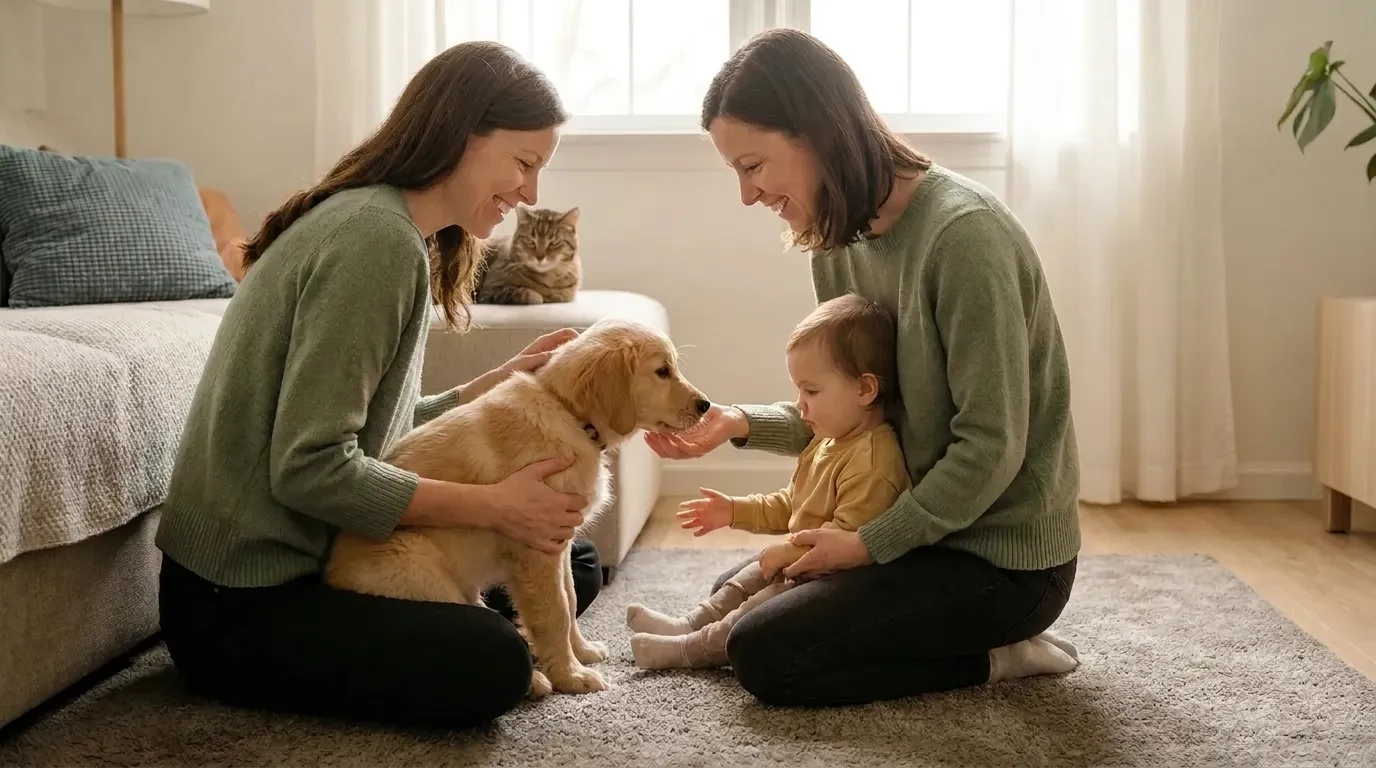
Bringing a puppy into a home that already has kids, a dog, or a cat is a lot at once, for everyone involved, puppy included. This is general, enthusiast-level guidance built around going slow and watching what each animal and each kid is actually telling you, not a training manual or a substitute for a trainer’s or vet’s read on your specific household. If anything described here starts looking like real fear, aggression, or a behavior concern rather than ordinary adjustment, that’s exactly the kind of thing worth a call to a local trainer or your vet.
Before the Puppy Even Arrives
A little setup ahead of time tends to make the first days calmer. A crate or a quiet corner gives your puppy somewhere to retreat when things feel like a lot, and your existing pets benefit from keeping their own undisturbed space too, a cat’s usual perch, a dog’s regular bed. Separate food bowls and a few extra toys on hand help avoid early competition over resources.
It’s also worth a short conversation with kids in the house beforehand about what a new puppy needs: quiet time, rest, and gentle hands. Setting that expectation early, before the excitement of a new puppy takes over, tends to make the first interactions go more smoothly.
Safe Zones and a Predictable Routine
A crate, playpen, or quiet room gives a puppy a place to decompress on its own terms. For a resident cat, a high perch or a room it can retreat to is just as important, so it has a way to opt out if it feels overwhelmed. A predictable routine around feeding, play, and potty breaks also tends to help a puppy settle in, since knowing roughly what comes next can ease a lot of early uncertainty.
Introducing Your Puppy to Kids
Supervision matters here more than almost anything else. Having kids sit on the floor and let the puppy approach, rather than rushing toward it, gives the puppy some say in how the interaction starts, which tends to go better for everyone. Keeping early interactions short and calm, and rewarding gentle behavior from the puppy, builds a foundation without asking too much too soon.
It’s worth teaching kids that a puppy eating or sleeping is off-limits for petting, and that offering a treat gently, without loud noises or sudden movements, tends to go over better than an excited rush. A puppy-free zone, somewhere the puppy can retreat to and kids know to leave alone, gives everyone a reset button when things feel like too much. None of this needs to be perfect from day one. Small, calm exposures, repeated often, tend to build toward a comfortable relationship over time.
Introducing Your Puppy to Other Dogs
Neutral territory, like a quiet park, on leashes, tends to work better than a first meeting at home, since it avoids either dog feeling territorial. Keep the first meeting short, and watch for loose, relaxed body language, a soft tail, easy movement, as a reasonably good sign. If either dog looks stiff, growls, or barks persistently, a calm separation and another try later, rather than pushing through, is usually the better call.
Once home, separate food bowls, separate toys, and supervision during early interactions all help prevent resource guarding. Letting an older dog set the pace, rather than expecting instant tolerance for a bouncy new puppy, tends to go more smoothly. A baby gate, used for a sight-and-scent introduction before direct contact, is a low-pressure way to let both dogs get used to each other gradually.
Introducing Your Puppy to a Resident Cat
This one usually takes the most patience. Scent swapping first, a cloth rubbed on the cat and offered to the puppy to sniff, and the reverse, lets both animals get used to each other’s presence before any face-to-face meeting. From there, a supervised visual introduction through a baby gate or crate, with calm behavior rewarded on both sides, tends to work better than a direct, unbarriered meeting.
Keeping the cat’s escape routes open, and never forcing either animal toward the other, matters throughout this process. Feeding the cat somewhere the puppy can’t reach avoids one common source of tension. Short initial sessions, just a few minutes, gradually extended as both animals seem more at ease, tend to produce a calmer long-term relationship than rushing the timeline.
A Few Common Bumps Along the Way
Even with a careful approach, a few predictable challenges tend to come up. A puppy that’s overexcited, jumping, nipping, barking, often settles with redirection to a toy, plenty of exercise and mental stimulation, and short, calm training sessions, since a tired puppy tends to be an easier puppy. An older pet that seems wary or fearful of the new puppy deserves patience and plenty of safe retreats rather than forced interaction; if that wariness looks more like significant, ongoing distress, hiding, persistent growling or hissing, a conversation with a trainer or vet experienced in multi-pet households can help more than general tips alone.
Resource guarding, a pet becoming possessive over food, toys, or a favorite spot, is worth watching for in any multi-pet household. Separate bowls, plenty of toys so there’s less to compete over, and calm supervision during play all help. Teaching a simple ‘drop it’ cue to your puppy is a useful general habit here too.
Why Taking It Slow Tends to Pay Off
A puppy that learns to interact calmly with kids and other animals, at its own pace, tends to grow into a more confident adult dog, and early positive experiences like these tend to support that kind of resilience more broadly. None of this is a guarantee, since every puppy and every household is different, but patient, low-pressure introductions are a reasonable, low-risk way to give everyone the best shot at a comfortable home. The ASPCA’s resources on socializing your dog and the Humane Society’s guidance on introducing a new dog are both useful further reading if you want to go deeper on any of this.
Keeping Things Calm After the First Introductions
The first meeting is just the start. Continued positive exposure, consistent routines, and separate resources for each pet all help keep things calm as everyone settles in. Puzzle toys and short, low-key training sessions give a puppy something constructive to do with its energy, which tends to ease a lot of friction in a busy household.
A Short Note on Your Role in All This
You’re the one setting the pace here, and a calm, patient, consistent approach tends to shape how everyone, puppy, kids, and existing pets, settles into the new normal. Celebrate the small wins, expect a few bumps, and remember that every household is a little different: what works smoothly for one family might need adjusting for another. If anything along the way looks like more than ordinary adjustment, a local trainer or your vet is always a reasonable next step, not a sign that something has gone wrong.
FAQ: How do I prepare my home for a new puppy joining kids and other animals?
Setting up separate safe spaces, like a crate for the puppy and a retreat spot for existing pets, along with separate food bowls and toys, tends to ease the first few days. A quick conversation with kids about gentle handling ahead of time helps too.
FAQ: What’s a reasonable way to introduce a puppy to young kids?
Close supervision, letting the puppy approach rather than rushing it, and keeping early sessions short and calm all tend to help. A puppy-free zone gives everyone a place to reset if things feel like too much.
FAQ: How should I introduce my new puppy to an older dog?
Neutral territory on leashes for the first meeting, short sessions, and watching body language closely all help. At home, separate resources and supervision matter, and letting the older dog set the pace tends to go better than rushing it.
FAQ: What should I keep in mind when a puppy meets a resident cat?
Patience matters most here. Scent swapping, then a barrier-based visual introduction, and keeping the cat’s escape routes open throughout, tend to produce a calmer outcome than a direct, unbarriered meeting.
FAQ: What if things don’t seem to be going smoothly?
Occasional bumps are normal. But persistent fear, aggression, or distress in any animal is worth bringing to a local trainer or your vet rather than trying to work through alone with general guidance.

