
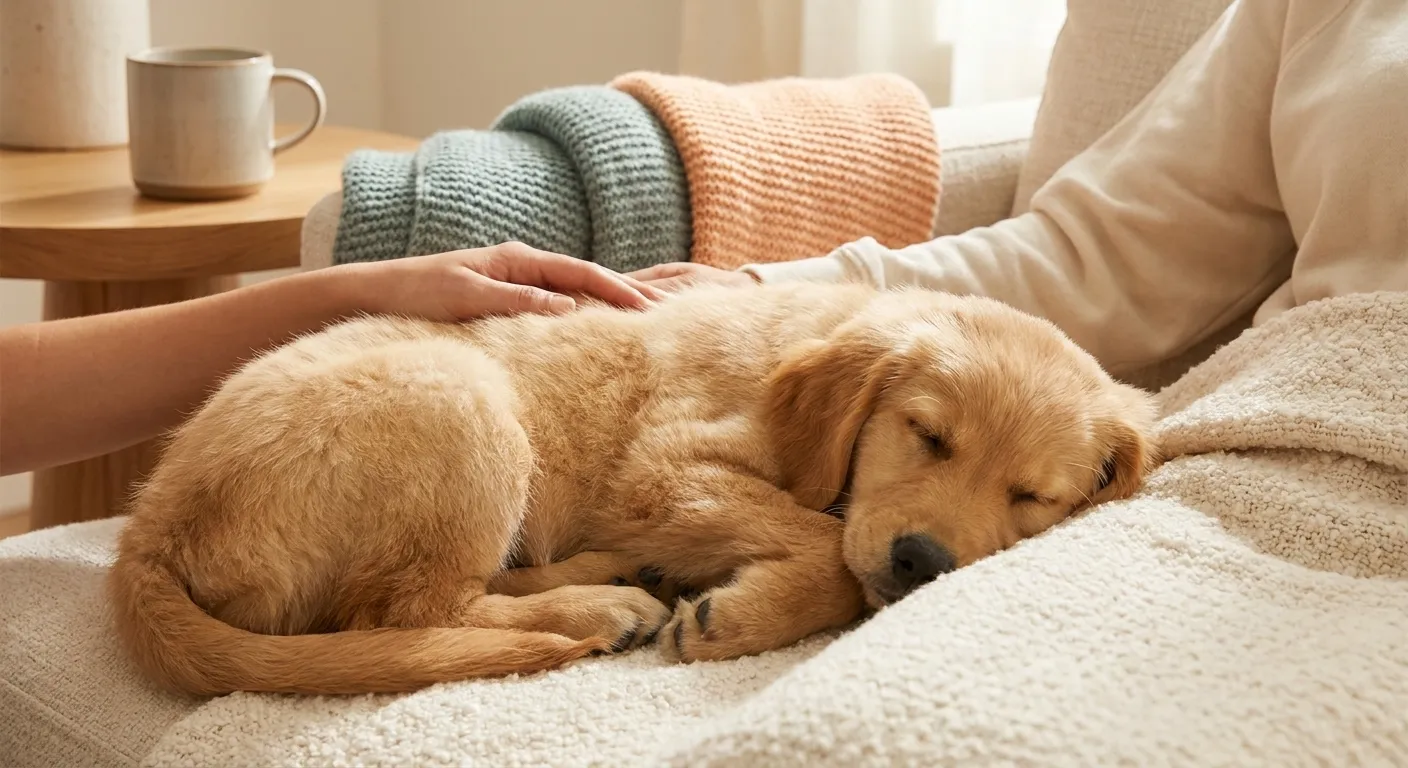
The importance of puppy naps begins with giving a young dog a place to rest without being continually invited into another activity. Rest belongs beside eating, toileting, gentle play and suitable learning opportunities in the daily plan. It is not a secret that guarantees a well-behaved puppy, and it should not be used to dismiss distress or a change in health.
This guide is for owners building a calm household routine. It offers a rest-space check, a flexible sequence around activities and an observation log you can discuss with your vet or qualified behaviour professional. It does not prescribe sleep hours for every puppy or diagnose behaviour from a nap schedule. This is general education, not veterinary advice; ask your vet about your puppy’s individual health and care needs.
Make rest a household agreement
Choose a place where your puppy can rest without people repeatedly approaching, touching or calling them. Dogs Trust’s new-home guidance recommends a quiet den and asks that the dog be left undisturbed there. Treat that as a practical household arrangement: everyone should know when the puppy is resting and what leaving them alone means.
For a family, agree on a simple rule such as observing from a distance rather than waking the puppy for a photograph or cuddle. Adults should supervise interactions between children and the puppy. Explain the resting area before visitors arrive so that the rule does not depend on repeatedly interrupting the dog to move people away.
Write the agreement on your household care sheet: where the rest area is, who manages the routine and what a visitor should do. Do not include a prediction that the puppy will sleep on command. The agreement concerns the people around the puppy and the opportunities they provide, not a guarantee about the dog’s response.
Check the space before introducing the puppy
Look at the area from the puppy’s access level. Remove inappropriate objects and follow the instructions for any barrier or enclosure you use. Consider nearby movement, doors and household activities. A quiet corner should still be a place you can supervise appropriately and reach when the puppy needs care. Do not improvise a closed space simply to make sleep happen.
Use bedding and equipment suited to the puppy and check their condition. If the puppy chews or damages an item, discuss a suitable alternative with your vet or a qualified professional rather than assuming the same material can remain unattended. This article does not declare a particular toy or bedding universally safe for every puppy.
If a crate forms part of the plan, it needs a careful introduction rather than being the automatic answer to restlessness. VCA’s crate-training guidance describes gradual training and an appropriate resting space. Follow the relevant instructions and seek help when needed. A crate should not be used as punishment or as a way to force a distressed puppy to sleep.
Plan a gentle transition after ordinary activity
After an appropriate activity, check the puppy’s ordinary needs before expecting rest. Has the planned toilet opportunity happened? Is there something in the environment that needs attention? Has the activity stopped, or are people still encouraging play? These are observations to make, not a formula that proves why the puppy is unsettled.
A hypothetical household sequence might be a suitable play or learning activity, a toilet opportunity appropriate to the puppy and a quiet period near the resting area. Adjust the sequence with your vet’s and trainer’s guidance. The example does not set exercise duration, toilet intervals or a mandatory sleep deadline.
Keep the transition simple. Put away the activity materials and reduce invitations to continue playing. Avoid repeatedly calling the puppy to the bed, touching them to check whether they are asleep or adding another exciting task because they have not settled immediately. Observe what they do and keep your expectations flexible.
Let the routine respond to the individual puppy
A daily plan can provide opportunities without becoming a rigid timetable. Write the activities and quiet periods in an order that fits the puppy’s care and your household. Ask your vet about feeding, toileting and activity questions rather than borrowing another puppy’s schedule as a rule. The right plan for your situation may need adjustment as needs change.
Dogs Trust’s guidance encourages a routine while recognising that puppies differ in how they settle into a new home. Use that principle to leave room for observation. A change in the day does not mean you need to compensate with a longer activity or enforce a nap. Return to the puppy’s needs and the calm environment you can provide.
Avoid turning one busy or unsettled period into a label such as stubborn or badly trained. Record what happened before and during it. If a concern repeats, take the specific observations to a qualified professional. Rest, learning and health can all raise questions; a nap chart should not replace an appropriate assessment.
Observe wakeful behaviour without diagnosing it
Make a short note about the context of an unsettled period. Was there a visitor, a noisy household activity or a new environment? What did the puppy actually do? Use descriptions such as moved between beds, vocalised or repeatedly approached a person. Do not claim those observations prove overtiredness, anxiety or a medical condition.
If the puppy appears distressed, do not continue a separation or confinement exercise simply because the clock says nap time. Return to the supported training plan and seek guidance. VCA’s crate-training advice emphasises gradual learning; use an appropriate plan rather than treating prolonged distress as something the puppy must endure to learn a lesson.
A change in alertness, appetite, comfort or usual behaviour deserves a conversation with your vet. Do not assume unusual inactivity is a successful nap intervention. Describe the change and follow the vet’s guidance about assessment. Rest education should help you notice the puppy’s needs, not encourage you to overlook a health concern.
Keep a small log that answers a useful question
Choose one question for the log, such as whether the resting area is interrupted during the afternoon. Record the activity before the quiet period, the setting, interruptions and your observation. Avoid repeatedly waking or handling the puppy to collect data. The log is a household note, not a clinical sleep measurement.
For a hypothetical entry, write: short lesson activity; usual toilet opportunity; puppy rested in den; visitor called puppy and rest ended. This is an illustration of how to write an observation, not a reported result or a claim about a real dog. The next household action might be explaining the visitor rule more clearly.
Review the notes for choices within your control. You may be able to move an activity away from the rest space, clarify who handles a toilet break or reduce repeated invitations to play. Make one practical change and observe again. Do not present a few entries as evidence that your routine prevents behaviour problems or produces a particular health outcome.
Keep learning and rest as separate opportunities
When the puppy is ready for an appropriate learning activity, use the plan agreed with your trainer or vet. A rest period is not time to wake the puppy for another repetition. Equally, providing naps does not teach the specific skills your household needs. Keep both on the care plan without making one a substitute for the other.
For social experiences, ask the appropriate professional how to introduce people and environments safely for your puppy. Avoid making the day a constant procession of visitors in the name of socialisation. The rest-space agreement can help you decide when people should step back. It does not establish a vaccine or exposure plan; those questions belong with your vet.
Visitors can take part in the calm routine by respecting the space and waiting for an appropriate interaction. Give them a specific instruction before arrival. If the puppy moves away or is resting, allow the pause instead of bringing them back for a greeting. This keeps the household’s actions consistent with the opportunity you intended to provide.
Begin with the space and one quiet transition
Check the rest area, agree that it will remain undisturbed and choose one ordinary activity-to-rest transition to observe. Leave room for toileting and other care needs, and keep the plan flexible. Bring repeated concerns or health changes to your vet and qualified behaviour support rather than escalating confinement or trying a sedating product.
Your first useful action is a household rest agreement and one clear log entry. The importance of puppy naps is in making room for rest within thoughtful care, while continuing to respond to the individual puppy. Provide the opportunity, observe gently and use professional help when the question goes beyond the routine.

