
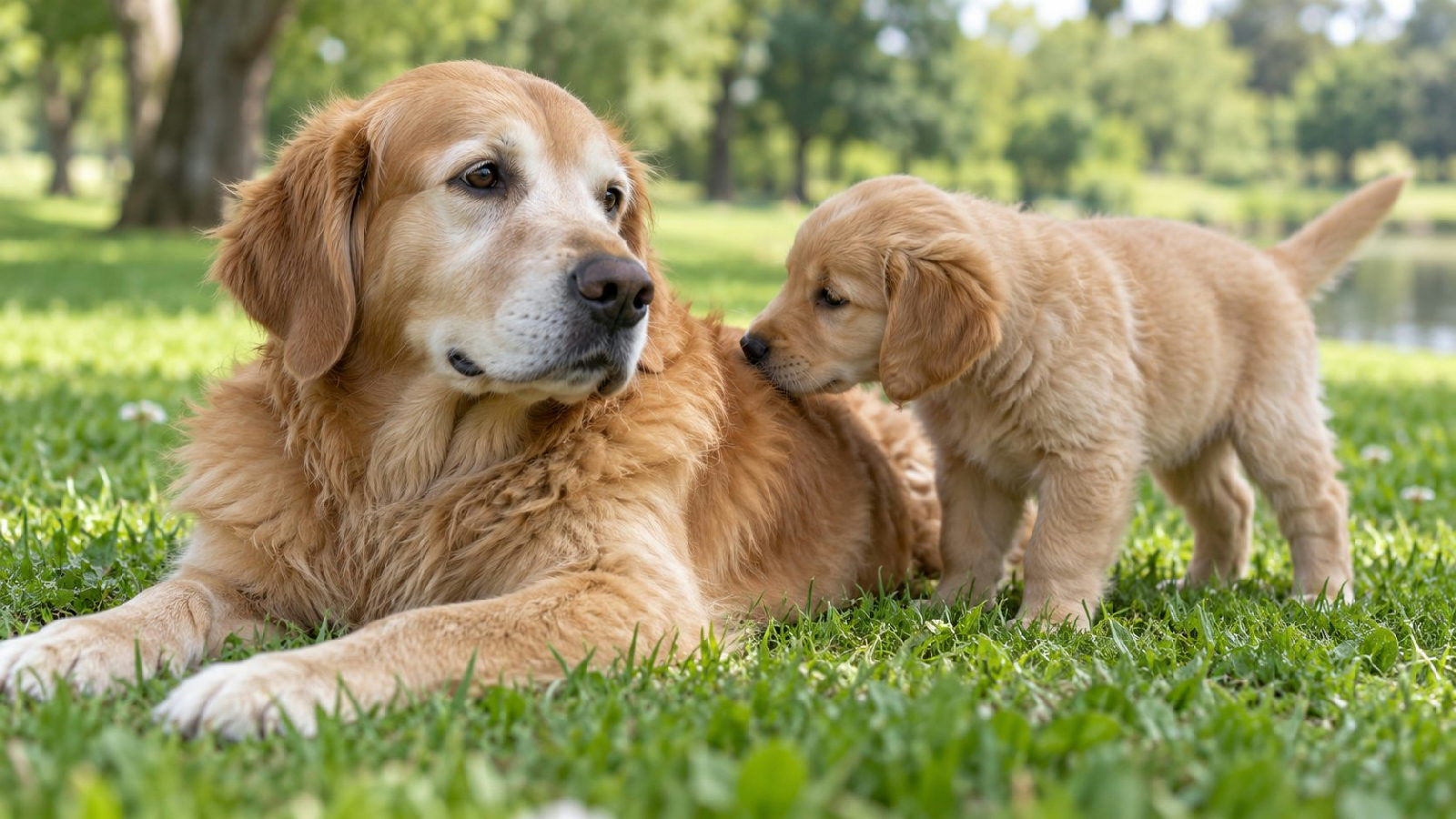
The calmest way to approach introducing a puppy to a calm adult dog is to choose a patient, puppy-friendly adult, meet on neutral ground with a parallel walk, keep leashes loose, and end the visit after a few relaxed minutes. Watch both dogs, not just your puppy, and let either one say “that’s enough” at any time. Short, quiet visits repeated over weeks are the whole plan.
A quick note on who is writing: this is general, enthusiast-level guidance from a puppy notebook, not advice from a trainer or a vet, and it is not a fix for a specific behavior issue. Before your puppy meets dogs outside your household, ask your vet when that fits your puppy’s vaccination plan. If either dog seems worried, stiff or overwhelmed, please loop in a professional trainer or your vet.
Introducing a puppy to a calm adult dog in six steps
If you only read one section, make it this one. Here is the routine this guide builds on:
- Check with your vet about when your puppy can meet dogs outside your household.
- Pick the right adult dog with a quick checklist and a chat with their owner.
- Agree on a short plan with the owner, including a simple “we’re done” signal.
- Start with a parallel walk on neutral ground, with plenty of space between the dogs.
- Allow a brief, loose-leash sniff only if both dogs look relaxed, then call them apart.
- End early and write it down in a simple visit log.
Starting from wherever you are
A lot of new owners find themselves wondering whether their puppy is “behind” on meeting other dogs. This guide doesn’t ask you to hit a deadline; it is a calm routine you can use whenever your vet says the timing is right for your puppy. This article focuses on a mentor dog from outside your home, such as a friend’s or relative’s dog. Bringing a second dog into your home is a different project, and a trainer is a good person to plan that with. For background reading, the American Veterinary Society of Animal Behavior publishes a puppy socialization position statement.
Choosing the right adult dog
The adult dog is the biggest choice in this whole process. Not every friendly dog wants to spend time with a puppy, and that is perfectly okay.
A mentor dog checklist
- The owner describes them as relaxed around puppies, based on past visits
- They are comfortable on leash near other dogs
- They tend to walk away or turn their head when they’ve had enough
- They have a gentle, low-key play style
- The owner says they’re healthy and up to date with their own vet care
- The owner is happy to keep visits short and end them early
Who to skip for now
- Dogs who guard toys, food or space
- Dogs who are elderly, sore or unwell, unless their owner and vet are comfortable
- Dogs with a history of fights or strong reactivity
- Dogs who seem stressed around puppies, even if they enjoy adult dogs
Questions to ask the owner
- Has your dog spent time around young puppies before? How did it go?
- Is there anything your dog doesn’t like, such as being sniffed at the face or approached while lying down?
- Does your dog have any toys, treats or spots they’re protective of?
- What does your dog usually do when they want a break?
- Are you comfortable ending the visit at any moment, for any reason?
Planning the first visit
A little planning keeps the visit calm for both dogs and both humans.
Pick a neutral spot
Meeting somewhere neither dog considers “theirs” is a common choice, such as a quiet path or a friend’s fenced yard. Ask your vet whether the location suits your puppy’s age and vaccination plan before you go.
What to bring
- A comfortable harness and leash for your puppy
- Plenty of small treats, kept in a pouch rather than loose in your hand
- Water, a bowl and poop bags
- A mat or towel so your puppy has a familiar spot during breaks
Agree on a “we’re done” signal
Before the dogs see each other, agree with the other owner on a simple phrase like “let’s wrap up.” Either of you can say it at any time, no explanation needed. It’s okay to say no to a greeting, and it’s okay to end a visit after one minute.
Leave toys and food out of it
Keep toys, chews and food bowls away from the meeting area for first visits. If you use treats, each handler rewards their own dog, with a good gap between them.
The first meeting, step by step
Start with a parallel walk
- Walk in the same direction with a comfortable gap between the dogs, each with their own handler.
- Let them notice each other while you keep moving.
- Close the gap a little only if both dogs look relaxed.
- Allow a brief sniff with loose leashes, for a few seconds.
- Call them apart cheerfully and reward both dogs.
Keep leashes loose
If you need to move your puppy away, walk away calmly rather than pulling. Small, calm exposures are the goal, so a short sniff and a walk away is a complete visit.
A quiet visit is a good visit
The dogs might sniff, wander apart, sniff the grass together and then mostly ignore each other. That’s a lovely first meeting. Let your puppy set the pace, and resist the urge to push for more interaction than the dogs choose.
Watching the adult dog’s comfort
Your job during the visit is to watch both dogs and step in early. Use a simple stop rule: if you notice any of the following from the adult dog, calmly call or lift your puppy away, give everyone a breather, and end the visit or keep the next one shorter.
- Turning the head away, walking off or trying to leave
- Lip licking, yawning or a hard stare
- A lifted lip, a growl or freezing
- Moving behind their owner or trying to hide
You don’t need to work out what each one means. Step back first, and note it in your log.
Don’t let the puppy pester
If your puppy jumps at the adult dog’s face, climbs on a dog who is lying down or keeps following a dog who walks away, redirect your puppy before the adult dog has to tell them off. Call your puppy back, offer a treat or a short game with you, and give the adult dog some space.
Short sessions and breaks
A few minutes at a time is plenty for a first visit. Ending while things are calm is the aim.
A sample visit plan
- Parallel walk for a few minutes.
- Short sniff and greet if both dogs look relaxed.
- Calm time nearby, each dog getting treats from their own handler at a distance.
- Brief supervised play only if both dogs invite it, with frequent breaks.
- End the visit while things are still easy.
This is just an example. Some pairs stay at step 1 or 2 for several visits, and that’s fine. Progress, not perfection.
Build over several visits
Try to see the same mentor dog a few times. If visits keep going smoothly, you can let them run a little longer or add a calm sit-together on a patio or in a yard. Change one thing at a time.
Let your puppy rest afterward
Plan a quiet nap or downtime at home after each visit, rather than stacking another outing on the same day.
For more calm socialization ideas, browse the other guides on Puppy Socialization.
A simple visit log
A notebook or a note on your phone makes it much easier to see progress. After each visit, jot down:
- The date, the place and which adult dog you met
- How long the visit lasted
- What happened: parallel walk only, brief sniff, calm time nearby, short play
- How your puppy looked: relaxed, curious, unsure or worried
- How the adult dog looked, and anything their owner noticed
- What you will try next time: same plan, one step more, or one step less
Looking back over a few visits helps you see small wins. A log is also handy to share if you ever talk to a trainer or your vet.
When to loop in a trainer or your vet
Some things are bigger than a puppy playdate. Loop in a professional trainer or your vet if:
- You have any question about vaccinations or when your puppy can meet other dogs
- Either dog growls, snaps or stiffens more than once
- Your puppy seems scared of dogs and it isn’t easing over several visits
- Your puppy panics or takes a long time to settle after a visit
- You’re planning to bring a second dog into your home
Questions to bring along
- When can my puppy meet dogs outside our household, and where?
- Is there anything about the mentor dog’s health I should ask their owner?
- Based on my visit log, what would you suggest as a next step?
- Are there signs you’d like me to watch for in my own puppy?
Bring your visit log along. Asking early is not a failure; it is exactly the right call.
FAQs
How old should my puppy be before meeting other dogs?
Ask your vet. Timing depends on your individual puppy and their vaccination plan, so that’s a conversation for your vet rather than a blog post.
What if the adult dog growls at my puppy?
Calmly move your puppy away, give both dogs space and end the visit. If it happens more than once, talk with a trainer or your vet before the next visit.
Should I let them sort it out themselves?
This guide takes the supervised route: watch closely and step in early. Don’t leave the adult dog to manage a pestering puppy alone.
Can my puppy have more than one mentor dog?
Yes. Introduce new adult dogs one at a time, using the same checklist and the same short visit plan.
What if my puppy is scared of the adult dog?
Add distance and let your puppy watch from farther away while getting treats from you. Let your puppy set the pace. If it doesn’t ease, loop in a trainer or your vet.
Small wins count. A calm sniff and a happy walk away is a great first meeting.
Further reading
- AVSAB puppy socialization position statement, a professional body’s view on the early months
- AVSAB humane dog training position statement (2021)

