
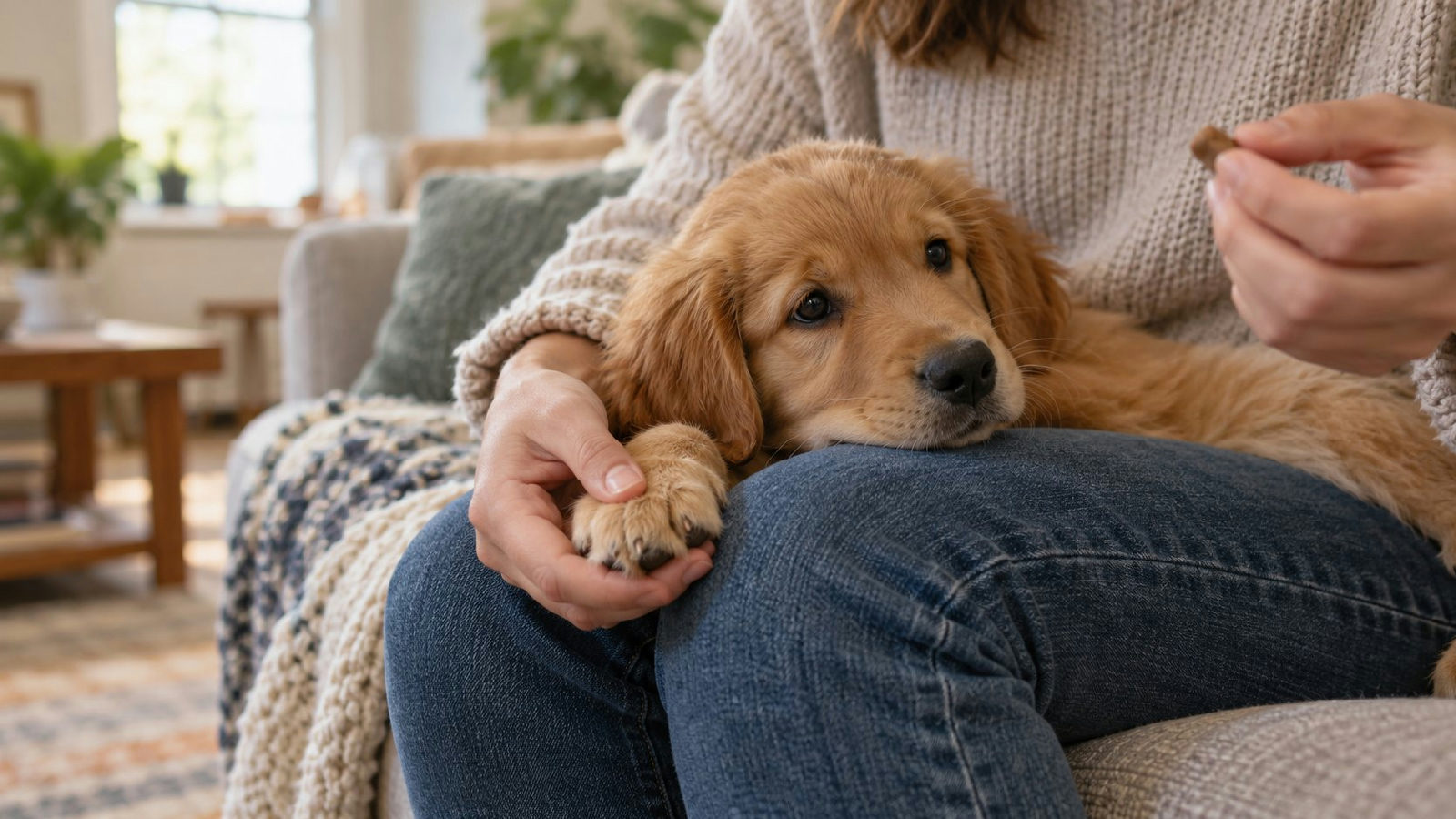
The calmest way to do puppy handling exercises is to touch one body part very briefly, follow it with a treat, and stop after a few repetitions, only moving to a longer touch while your puppy stays relaxed. Short, happy sessions spread over days and weeks are the whole plan. Let your puppy set the pace, watch their body language, and give them a clear way to say “not right now.”
A quick note on who is writing: this is general, enthusiast-level guidance from a puppy notebook, not advice from a trainer or a vet, and it is not a fix for a specific behavior issue. It is about getting comfortable with touch, not about checking your puppy’s health. If you notice any redness, odor, discharge, swelling or soreness anywhere, stop and call your vet. If your puppy seems very worried about being handled, please loop in a professional trainer or your vet.
Puppy handling exercises for paws, ears and mouth in five steps
If you only read one section, make it this one. Here is the routine this guide builds on:
- Pick one body part per session: a paw, an ear, the collar area or the chin.
- Choose a calm moment, like when your puppy is relaxed and a little sleepy.
- Touch briefly, then treat. Touch first, treat second, every time.
- Repeat three to five times, then end the session while it still feels easy.
- Write it down in a simple handling log, then pick the next small step for another day.
Starting from wherever you are
If your puppy already pulls their paw away the moment you reach for it, take a breath. A lot of new owners find their puppy is happy with belly rubs but wriggly about feet or ears. This guide doesn’t ask you to hit a deadline; it is a calm routine you can start today, at whatever level your puppy is comfortable with. For background reading on gentle, reward-based approaches, the American Veterinary Society of Animal Behavior publishes a humane dog training position statement.
Make a simple handling list
Think about the everyday moments when your puppy will be touched, and jot down the body parts involved. A starter list might look like this:
- Paws: wiping muddy feet, holding a paw, touching between the toes, touching nails
- Ears: stroking the head, touching the base of the ear, holding the ear flap
- Collar area: touching the collar, a finger under the collar, a gentle collar hold
- Mouth: touching the chin, the side of the muzzle, a brief lip lift
- Body: the back, the side of the belly, the base of the tail
- Gear: putting on a harness, a towel rub, a soft brush
Order them from easy to harder
Put the touches your puppy already enjoys at the top, like a stroke along the back. Put the ones your puppy pulls away from further down. You can always reorder the list once you see how your puppy responds. Every puppy is different, so your list will look different from anyone else’s.
Setting up short, calm sessions
What you’ll need
- Small, soft treats your puppy already loves
- A comfortable spot, like a mat or the floor beside you
- A quiet room with few distractions
- A minute or two of your time
The basic pattern
- Say a cue word like “paw” or “ears” so your puppy knows what’s coming.
- Touch briefly, very lightly.
- Treat right away.
- Pause and let your puppy settle.
- Repeat a few times, then end the session.
Keep the order the same each time: cue, touch, treat. A few minutes at a time is plenty, and several tiny sessions in a day are fine.
Getting the household on board
Handling practice is easier when everyone at home uses the same steps and the same cue words. Start with you, then add calm family members once your puppy is relaxed with you. Children can join with close adult supervision, starting with simple touches like a stroke along the back.
Paws and nails
Step by step
- Touch the outside of a front leg near the shoulder. Treat.
- Slide your hand down toward the paw. Treat.
- Touch the top of the paw briefly. Treat.
- Gently hold the paw for a second. Treat and release.
- Over many sessions, lightly touch between the toes, then each nail. Treat each time.
- Later, let your puppy sniff a towel you’ll use for paw wipes, then do one gentle wipe. Treat.
Tips for paws
- Work on one paw per session.
- Practice back paws as well as front paws, starting from step 1 again.
- Leave nail trimming itself to your vet or groomer, or ask them to show you how before you try at home.
Ears and collar grabs
Ears
- Stroke the top of your puppy’s head. Treat.
- Touch the base of an ear. Treat.
- Gently hold the ear flap for a second. Treat and release.
- Over many sessions, build up to holding the ear flap a little longer. Treat.
This is touch practice only. If you notice redness, odor, discharge or your puppy seems sore, stop and call your vet rather than checking further yourself.
Collar grabs
- Touch the collar. Treat.
- Gently hook a finger under the collar. Treat and release.
- Hold the collar for a second. Treat.
- Over time, practice a gentle hold from different sides. Treat.
Play this like a game, with a treat every time a hand reaches toward the collar.
Mouth and teeth
Go extra slowly here, and keep each touch very brief.
Step by step
- Touch your puppy’s chin. Treat.
- Touch the side of the muzzle. Treat.
- Lift a lip for a second. Treat and release.
- Over many sessions, build up to a slightly longer lip lift. Treat.
Things to keep in mind
- For questions about tooth brushing or which products to use, ask your vet.
- If your puppy mouths your hand, pause, offer a chew toy instead and try again later.
- If you notice anything about the teeth or gums that worries you, stop and contact your vet.
Body, tail and gentle holds
Whole-body touch
- Run a hand slowly along your puppy’s back. Treat.
- Touch the side of the belly. Treat.
- Touch the base of the tail briefly. Treat.
Practicing a gentle hold
Place one arm lightly around your puppy’s chest and the other around their back end for just a second, then release and treat. Build up slowly, one second at a time. Don’t squeeze or pin your puppy, and release right away if they wriggle.
Letting your puppy opt out
Consent is part of the routine. Some owners teach a “chin rest” on a hand or a folded towel: while the chin is resting, handling continues; when your puppy lifts their chin, you pause. It gives your puppy a clear way to say “not right now,” and gives you a clear signal to stop.
For more calm exposure ideas, browse the other guides on Puppy Socialization.
A simple handling log
A notebook or a note on your phone makes it much easier to see progress. After each session, jot down:
- The date and the body part you practiced
- The step you reached: touch, hold for a second, longer hold
- How many repetitions you did
- How your puppy looked: relaxed, curious, unsure or worried
- Whether they still took treats
- What you will try next time: same step, one step harder, or one step easier
Looking back over a week of notes helps you see small wins. A log is also handy to share if you ever talk to a trainer or your vet.
Signs your puppy needs a break
This guide uses one simple house rule: if you notice any of the following during a session, end the session and make the next one easier. You don’t need to work out what it means; just step back and note it in your log.
- Pulling a paw or head away
- Turning away, licking lips or yawning
- Stiffening or freezing
- Mouthing your hand or wriggling to get down
- Lifting their chin off the chin rest
- Refusing treats they normally love
What to do
Calmly stop, give your puppy space, and next time go back a step on your list.
When to loop in a trainer or your vet
Some things are bigger than a handling game. Loop in a professional trainer or your vet if:
- You notice redness, odor, discharge, swelling or soreness anywhere
- Your puppy yelps or flinches when one spot is touched
- Your puppy growls, snaps or panics during handling
- Your puppy seems more worried over time rather than less
- You have questions about nail trims, ear care or tooth brushing
Questions to bring along
- Could you show me how you’d like nails, ears and teeth looked after for my puppy?
- Is there anything you’d like me to practice before our next visit?
- Based on my handling log, what would you suggest as a next step?
Bring your handling log along. Asking early is not a failure; it is exactly the right call.
FAQs
How often should I do puppy handling exercises?
A minute or two, once or twice a day, fits most routines. Your handling log is the best guide to your own puppy’s pace.
What if my puppy keeps mouthing during handling?
Make sessions shorter, offer a chew toy and go back a step. If it continues, a trainer can help.
Should other people practice handling too?
Yes, once your puppy is relaxed with you. Start with calm family members using the same steps and cue words.
My puppy is fine with paws but not ears. What should I do?
Keep working on the easier areas and go extra slowly with the tricky ones. Every puppy is different.
Can older puppies do these exercises too?
Yes. The routine is the same at any age: start at a level your dog is comfortable with and go slowly.
Progress, not perfection. Every relaxed paw hold counts.
Further reading
- AVSAB humane dog training position statement (2021)
- AVSAB puppy socialization position statement, a professional body’s view on the early months

