
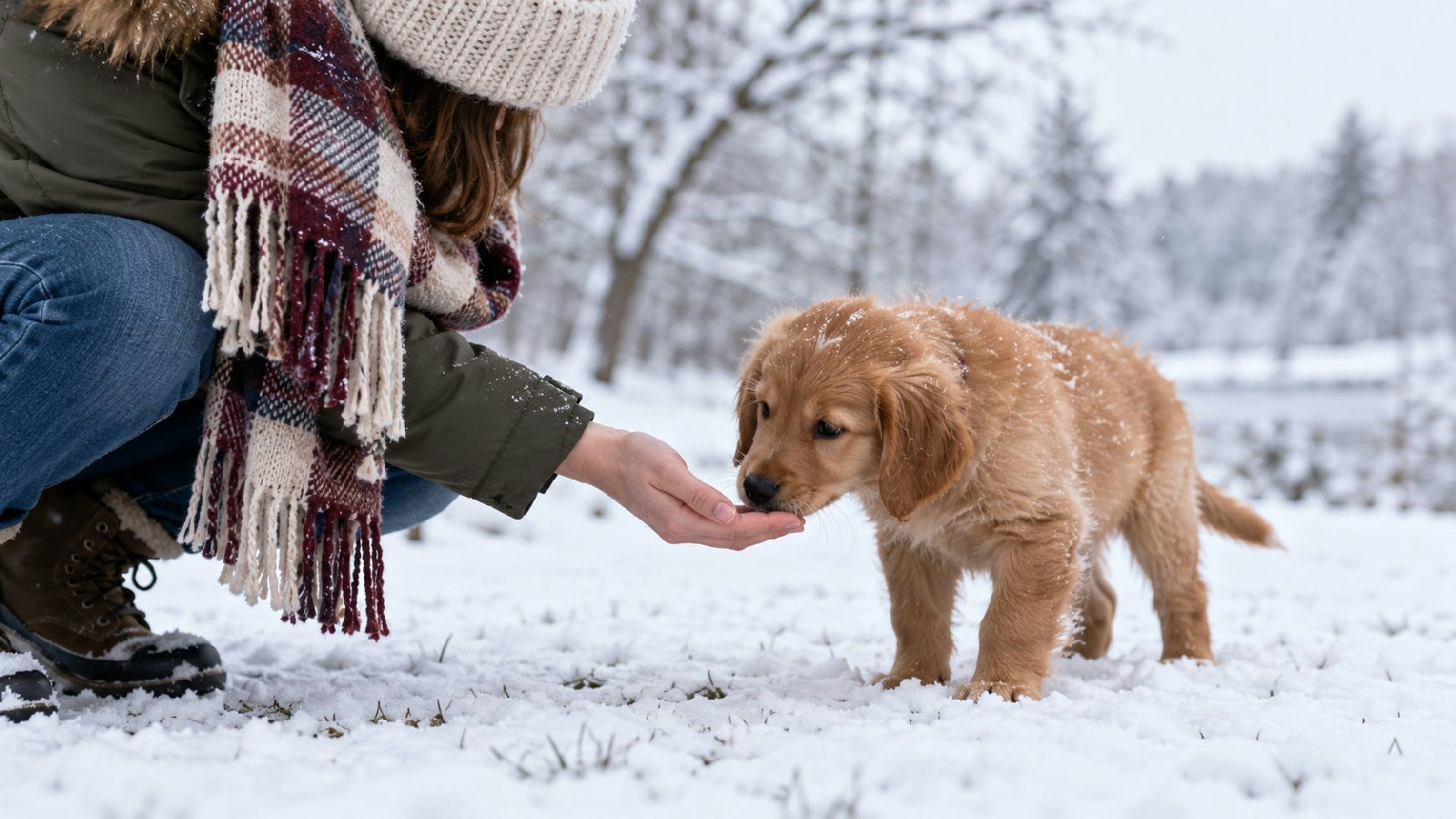
The calmest way to handle a puppy meeting new people is to start with a calm helper at a distance, let your puppy choose whether to go closer, keep each greeting to a few seconds, and only add something new, like a hat or a big coat, while your puppy stays relaxed. Short, happy meetings spread over days and weeks are the whole plan. Let your puppy set the pace, watch their body language, and remember it’s okay to say no to a greeting.
A quick note on who is writing: this is general, enthusiast-level guidance from a puppy notebook, not advice from a trainer or a vet, and it is not a fix for a specific behavior issue. If your puppy seems very worried about people, or it isn’t easing, please loop in a professional trainer or your vet. Questions about when your puppy can visit public places belong with your vet.
Puppy meeting new people: hats, beards, uniforms and more in six steps
If you only read one section, make it this one. Here is the routine this guide builds on:
- Make a people list of the looks, movements and ages your puppy is likely to meet.
- Start with a friend you can brief ahead of time, in a quiet spot.
- Begin at a distance and treat your puppy for simply looking.
- Let your puppy choose whether to approach, with the helper staying still and low-key.
- Keep greetings to a few seconds, then call your puppy away and reward.
- Change one thing at a time next session, like adding a hat, and write it down in a people log.
Starting from wherever you are
If your puppy already backs away from the neighbor in the big winter hat, take a breath. A lot of new owners find their puppy is happy with the family but unsure about anyone who looks a little different. This guide doesn’t ask you to hit a deadline; instead, it is a calm puppy meeting new people routine you can start today, at whatever level your puppy is comfortable with. For background reading, the American Veterinary Society of Animal Behavior publishes a puppy socialization position statement.
Make a simple people list
A list helps you spot gaps. First, think about the kinds of people your puppy will see over the coming months.
Different looks
- Hats, hoods and beanies
- Sunglasses and regular glasses
- Beards and mustaches
- Face masks or scarves over the face
- Big winter coats, raincoats and backpacks
- Uniforms and reflective vests, like delivery drivers or mail carriers
Different movements and sounds
- People jogging, cycling or skateboarding
- Someone using a cane, walker or wheelchair
- Strollers or shopping carts going by
- Loud laughter, deep voices or high voices
- Children playing, with adult supervision
Different ages and sizes
- Tall and short adults
- Older adults
- Teens and children, with adult supervision
Order them from easy to harder
Calm, familiar people in ordinary clothes go at the top. After that, add fast movement, bulky outfits, covered faces and groups further down. You can always reorder the list once you see how your puppy responds. Every puppy is different, so your list will look different from anyone else’s.
Watching counts too
A puppy meeting new people doesn’t need to greet everyone. Sitting at a calm distance and watching people go by while you hand out treats is a full session on its own. Some ideas:
- Watch deliveries from a window, with a treat each time someone walks up the path.
- Sit on a quiet bench at the edge of a park and treat for each person who walks past.
- From your yard or porch, watch neighbors in hats and coats.
Before heading to parks or shopping streets, ask your vet when public places fit into your puppy’s plan.
A puppy meeting new people plan, step by step
- Start at a distance where your puppy stays relaxed.
- Treat for looking. When your puppy looks at the person, give a treat.
- Let your puppy move closer if they want, with a loose leash.
- The helper stays still, turned a little sideways, hands low, no staring.
- Brief sniff. If your puppy sniffs and stays relaxed, the helper can offer a gentle chest scratch.
- Call your puppy away after a few seconds and reward them.
Keep the order the same each time. A few minutes at a time is plenty.
If your puppy hangs back
That’s a valid choice. Let your puppy watch from where they are and get treats from you. Skip luring them closer with food held by the helper, and try again another day from farther away.
Change one thing at a time
If your puppy is relaxed with a helper in everyday clothes, the helper could add a hat next time. After that, try sunglasses, and later a big coat or a backpack. Small, calm exposures, one change per session.
Seasonal chances to practice
Late fall and the holidays bring lots of new looks: bulky coats, scarves pulled up, knit hats, gloves, big shopping bags and neighbors on ladders hanging lights. Add these to your list and practice them from a comfortable distance. Also, skip crowded events and keep sessions short.
Coaching helpers on what to do
Most people love puppies and mean well. A quick briefing turns an eager friend into a great helper.
A helper script you can copy
- “Please let the puppy come to you. Stand or crouch a little sideways and wait.”
- “Keep your hands low, and skip reaching over the head.”
- “A soft voice and slow movements are perfect.”
- “Picking the puppy up is a no for now.”
- “A few seconds is great, then I’ll call the puppy back.”
- “If the puppy moves away, that’s our cue to stop.”
It’s okay to say no
Strangers sometimes rush toward puppies. In that case, you can say, “We’re practicing, could you let her come to you?” or simply, “Not today, thanks.” It’s okay to say no to a greeting.
Respecting everyone’s comfort
Not every person wants to meet a puppy. Ask before involving anyone, and keep your puppy from jumping on or approaching someone who hasn’t said yes.
For more calm exposure ideas, browse the other guides on Puppy Socialization.
A simple people log
A notebook or a note on your phone makes it much easier to see progress. After each session, jot down:
- The date, the place and who your puppy saw or met
- What was new: a hat, a beard, a uniform, a big coat, a bike
- How close your puppy chose to get: watched, approached, sniffed a hand
- Your puppy’s look: relaxed, curious, unsure or worried
- Whether they still took treats
- Next time’s plan: same step, one step harder, or one step easier
After a couple of weeks of puppy meeting new people sessions, the log makes it easy to spot gaps, like lots of adults in everyday clothes but no one in a reflective vest. It is also handy to share if you ever talk to a trainer or your vet.
Signs your puppy needs a break
This guide uses one simple house rule: if you notice any of the following during a session, end the session and make the next one easier. You don’t need to work out what it means; just step back and note it in your log.
- Tail tucked, ears pinned back or body low
- Backing away or hiding behind your legs
- Yawning, lip licking or shaking off when not tired or wet
- Freezing or going very still
- Refusing treats they normally love
- Barking or growling at a person
What to do
Calmly move away, give your puppy space and a quiet moment with you. Next time, start farther away or with an easier helper, and write it down in your log.
When to loop in a trainer or your vet
Some things are bigger than a people list. Loop in a professional trainer or your vet if you notice:
- Worry about many people, not just one look
- Frequent barking or growling at people
- Panic, or a long time to settle after a session
- More worry over time rather than less
- Any question about when your puppy can visit public places
Questions to bring along
- When can my puppy visit parks, stores and other public places?
- Based on my people log, which items would you work on next?
- Are there signs you’d like me to watch for in my puppy?
Bring your people log along. Asking early is not a failure; it is exactly the right call.
FAQs
How many people should my puppy meet?
There’s no set number. Variety and calm experiences are the focus, and your people log is the best guide to your own puppy’s pace.
Should strangers give my puppy treats?
This guide keeps it simple: treats come from you, especially at first. Once your puppy is relaxed and approaching a familiar helper, you can decide whether the helper offers one.
My puppy jumps on everyone. What should I do?
Ask helpers to turn away if your puppy jumps and to greet only when four paws are on the floor. Then reward calm greetings. A trainer can help if jumping continues.
What about puppy meeting new people in uniforms, like delivery drivers?
Watching from a window or a distance while you hand out treats is a great start. There’s no need to ask busy workers to stop and greet.
Is it too late if my puppy is older?
The routine in this guide is the same at any age: start at a level your dog is comfortable with and go slowly. If you’re worried, your vet or a trainer can talk it through with you.
Small wins count. A relaxed sniff of a hand is a lovely step forward.
Further reading
- AVSAB puppy socialization position statement, a professional body’s view on the early months
- AVSAB humane dog training position statement (2021)

